Skip to content
The Kids Research Institute Australia logo
Donate

Search

Research

Built Environments And Child Health in WalEs and AuStralia (BEACHES): a study protocol

Childhood obesity and physical inactivity are two of the most significant modifiable risk factors for the prevention of non-communicable diseases. Yet, a third of children in Wales and Australia are overweight or obese, and only 20% of UK and Australian children are sufficiently active.

Research

How does the school built environment impact students’ bullying behaviour? A scoping review

School bullying is a public health concern affecting the physical and mental health of children and young people. While school-based interventions to prevent bullying have been developed internationally, the effectiveness of many interventions has been mixed and modest.

Research

‘It’s All About Context’: Building School Capacity to Implement a Whole-School Approach to Bullying

Student bullying behaviours are a significant social issue in schools worldwide. Whilst school staff have access to quality bullying prevention interventions, schools can face significant challenges implementing the whole-school approach required to address the complexity of these behaviours.

Research

“Why don’t I look like her?” How adolescent girls view social media and its connection to body image

Adolescent girls appear more vulnerable to experiencing mental health difficulties from social media use than boys. The presence of sexualized images online is thought to contribute, through increasing body dissatisfaction among adolescent girls.

Research

Exploring offending characteristics of young people with foetal alcohol spectrum disorder in Western Australia

Neurodevelopmental impairments resulting from Foetal Alcohol Spectrum Disorder (FASD) can increase the likelihood of justice system involvement. This study compared offence characteristics in young people with FASD to demographically matched controls (n = 500) in Western Australia.
Research

Get it right, make it easy, see it all: Viewpoints of autistic individuals and parents of autistic individuals about the autism diagnostic process in Australia

The clinical process for being evaluated for an autism diagnosis is often time consuming and stressful for individuals and their caregivers. While experience of and satisfaction with the diagnostic process has been reviewed in the literature, few studies have directly investigated the viewpoints of individuals diagnosed with autism and caregivers of autistic individuals about what is important in the autism diagnostic process.

Research

Toward better characterization of restricted and unusual interests in youth with autism

Despite being highly prevalent among people with autism, restricted and unusual interests remain under-researched and poorly understood. This article confirms that restricted interests are very frequent and varied among children and adolescents with autism. It also further extends current knowledge in this area by characterizing the relationship between the presence, number, and type of restricted interests with chronological age, sex, cognitive functioning, and social and communication symptoms.

News & Events

Parents’ top tips for managing their kids’ device use

Have you ever wondered how other parents manage their kids’ device use? As part of a survey for our Cyber Savvy Project, The Kids researchers asked a group of parents for their top tips regarding their child's use of devices.
Research

Assessing functioning for individuals with neurodevelopmental conditions: Current clinical practice in Australia

In the disability sector globally, and specifically in Australia, assessments of functioning have become key to diagnostic processes, and accessing therapy and funding. Over half of all individuals accessing support through Australia's National Disability Insurance Scheme have a neurodevelopmental condition diagnosis.

Research

Content validation of common measures of functioning for young children against the International Classification of Functioning, Disability and Health and Code and Core Sets relevant to neurodevelopmental conditions

Young children who have developmental delay, autism, or other neurodevelopmental conditions can have difficulties doing things in different areas of their life. What they can and cannot do is called their level of functioning. There are lots of assessment measures that aim to assess functioning.

News & Events

CoLab Early Years Initiative

As we all know, we only get one start in life. Like the Minderoo Foundation, our partners in CoLab, we are determined to ensure that every start is a strong one for children across Australia.
Research

The course and prognostic capability of motor difficulties in infants showing early signs of autism

Delays within the motor domain are often overlooked as an early surveillance marker for autism. The present study evaluated motor difficulties and its potential as an early predictive marker for later autism likelihood in a cohort of infants showing early behavioral signs of autism aged 9-14 months. The motor domain was evaluated using the motor subscales of the Mullen Scales of Early Learning at baseline, and at a 6-month follow-up.

Research

Analysis of common genetic variation and rare CNVs in the Australian Autism Biobank

Autism spectrum disorder (ASD) is a complex neurodevelopmental condition whose biological basis is yet to be elucidated. The Australian Autism Biobank (AAB) is an initiative of the Cooperative Research Centre for Living with Autism (Autism CRC) to establish an Australian resource of biospecimens, phenotypes and genomic data for research on autism.

Research

Subgroups of Temperament Associated with Social-Emotional Difficulties in Infants with Early Signs of Autism

Links between temperament and social-emotional difficulties are well-established in normative child development but remain poorly characterized in autism. We sought to characterize distinct temperament subgroups and their associations with concurrent internalizing and externalizing symptoms in a sample of 103 infants showing early signs of autism.

Research

Parent-reported Early Atypical Development and Age of Diagnosis for Children with Co-occurring Autism and ADHD

Autism and attention-deficit/hyperactivity disorder (ADHD) often co-occur. This survey of 288 New Zealand parents of children diagnosed with autism, ADHD, or both conditions, examined the relations between age of diagnosis and early atypical development, the age specialist consultation was needed and types of specialists seen.

Research

Potential role for immune-related genes in autism spectrum disorders: Evidence from genome-wide association meta-analysis of autistic traits

Autism spectrum disorders are complex, with a strong genetic basis. Genetic research in autism spectrum disorders is limited by the fact that these disorders are largely heterogeneous so that patients are variable in their clinical presentations. To address this limitation, we investigated the genetics of individual dimensions of the autism spectrum disorder phenotypes, or autistic-like traits. These autistic-like traits are continuous variations in autistic behaviours that occur in the general population.

News & Events

Meaningful moments build young brains

Reading to your child is one of the easiest, most enjoyable activities you can do as a parent or caregiver.
News & Events

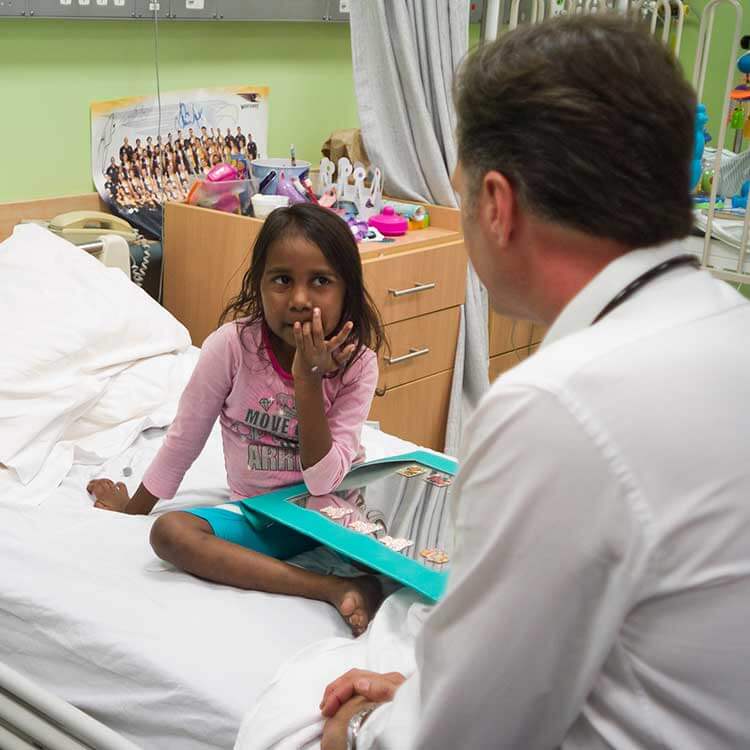
Bold bid to end rheumatic heart disease

Some of the nation’s leading medical researchers will converge on Darwin this week to step out a plan to wipe out rheumatic heart disease.

News & Events

Why you shouldn't let your child cross the road until they're ten years of age

At what age does your child have the mental capacity to cross the road alone? Our researchers have the answer and it's older than you might think.