
Search
This study provides evidence that continued participation in playgroups is associated with better outcomes for children from disadvantaged families.
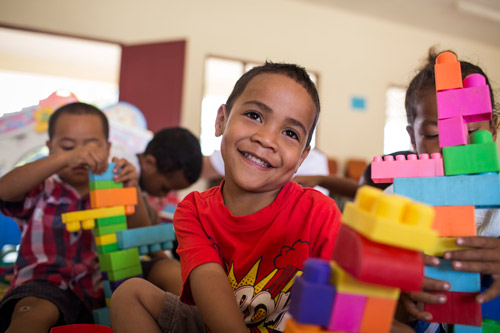
In Australia, community playgroups are seen as the ‘soft touch’. But a research project in Tonga is finding the benefits can last a lifetime.

New research by The Kids Research Institute Australia has found children who attend playgroups achieve better early primary school outcomes.
The importance of play for a child’s development is irrefutable. Playgroups provide a safe environment for children of similar ages to play and develop prior to starting school.
Childcare services such as preschools and long day care centres have been identified as a key setting to promote physical activity in early childhood as they provide access to large numbers of children for prolonged periods. Yet, specific standards for the type and amount of physical activity children accumulate whilst attending childcare are lacking. The purpose of this study was to derive population-referenced percentile values for children's total movement and energetic play whilst attending early childhood education and care services.
The early years is a critical stage to establish optimal nutrition and movement behaviours. Community playgroups are a relaxed environment for parents with a focus on social connection and supporting parents in their role as 'First Teachers'. Playgroups are therefore an opportunistic setting to promote health behaviours in the early years.
Knowledge of developmental trends in meeting age-specific 24-hour movement behaviour guidelines is lacking. This study describes developmental trends in device-measured physical activity and sedentary time over a three-year period among Western Australian children aged two to seven years, including differences between boys and girls.
Daily physical activity is critical during the early years of life for facilitating children's health and development. A large proportion of preschool children do not achieve the recommended 3 h of daily physical activity. Early childhood education and care (ECEC) services are a key setting to intervene to increase physical activity. There is a significant need for ECEC specific physical activity policy, including clearer guidelines on the amount of physical activity children should do during care, and strategies for implementation of these guidelines.
The environmental influences on early childhood development are understudied. The association between vegetation cover (i.e., trees, shrubs, grassed areas) in four key behaviour settings and socioemotional functioning was investigated in 1196 young children (2–5 years).
A significant number of children attend Early Childhood Education and Care (ECEC). ECEC is an important environment and behaviour setting for young children. Time spent outdoors is positively associated with children's physical activity levels, yet increased time spent physically active outdoors may expose young children to traffic-related air pollution, particularly in ECEC centres located in high traffic areas.