
Search
The Infectious Disease Ecology and Modelling team led by Professor Nick Golding, combines mathematical and statistical modelling, ecology, and public health to address malaria and other infectious and vector-borne diseases. The team uses modelling and maps to measure the risk posed by some of the world’s most important and neglected diseases – including malaria, Japanese Encephalitis and COVID-19 – and provide rapid modelling analyses to policy makers.
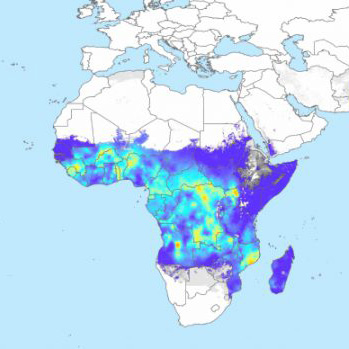
Malaria remains one of the leading causes of death, particularly in Africa and among children.
Nick Golding BSc DPhil Honorary Research Fellow Nick.Golding@thekids.org.au Honorary Research Fellow Professor Nick Golding is the UWA Chair in
The Vector Atlas aims to update and create vector species maps and spatial products that improve disease prediction, mitigation and preparedness.
Contact tracing is an important public health measure used to reduce transmission of infectious diseases. Contact tracers typically conduct telephone interviews with cases to identify contacts and direct them to quarantine, with the aim of preventing onward transmission. However, in situations where caseloads exceed the capacity of the public health system, timely interviews may not be feasible for all cases. Here we present a modelling framework for assessing the impact of different case interview prioritisation strategies on disease transmission.
The global human population is still growing such that our collective enterprise is driving environmental catastrophe. Despite a decline in average population growth rate, we are still experiencing the highest annual increase of global human population size in the history of our species-averaging an additional 84 million people per year since 1990.
Children are more vulnerable than adults to climate-related health threats, but reviews examining how climate change affects human health have been mainly descriptive and lack an assessment of the magnitude of health effects children face. This is the first systematic review and meta-analysis that identifies which climate-health relationships pose the greatest threats to children.
Australian states and territories used test-trace-isolate-quarantine (TTIQ) systems extensively in their response to the COVID-19 pandemic in 2020-2021. We report on an analysis of Australian case data to estimate the impact of test-trace-isolate-quarantine systems on SARS-CoV-2 transmission.
Following widespread exposure to Omicron variants, SARS-CoV-2 has transitioned to endemic circulation. Populations now have diverse infection and vaccination histories, resulting in heterogeneous immune landscapes. Careful consideration of the value of ongoing vaccination is required through the post-Omicron phase of COVID-19 management to minimise disease burden.
Disease surveillance data was critical in supporting public health decisions throughout the coronavirus disease 2019 (COVID-19) pandemic. At the same time, the unprecedented circumstances of the pandemic revealed many shortcomings of surveillance systems for viral respiratory pathogens. Strengthening of surveillance systems was identified as a priority for the recently established Australian Centre for Disease Control, which represents a critical opportunity to review pre-pandemic and pandemic surveillance practices, and to decide on future priorities, during both pandemic and inter-pandemic periods.